Material Overview
Paper Straws
Made from multiple layers of paper bonded with food-safe adhesives, sometimes coated for limited water resistance.
PureStalk C-Series (PLA-Based, CelluMeld™)
Built on a polylactic acid (PLA) backbone made from fermented plant starches, usually corn. C-Series uses CelluMeld™ technology and is engineered for cold drinks and industrial composting. It's our cost-effective product line.
PureStalk M-Series (PHA-Based, CelluMeld™)
Built on a polyhydroxyalkanoates (PHA) backbone made by bacteria fermenting plant oils and sugars. M-Series uses CelluMeld™ technology and is engineered for warm drinks, higher heat tolerance, and broader environmental compatibility, including home composting, soil, and marine environments.
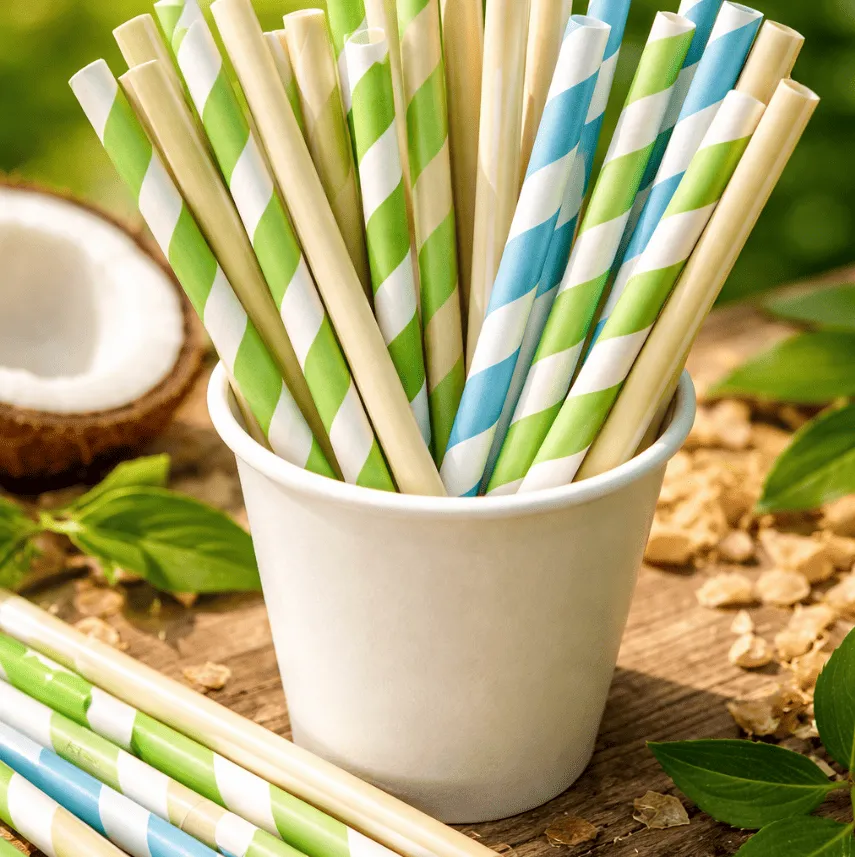
Paper straws
Comparison Table
| Feature | Paper | C-Series (PLA) | M-Series (PHA) |
|---|---|---|---|
| Performance in Cold Drinks | 30-45 minutes before soggy | 2+ hours, no degradation | 2+ hours, no degradation |
| Heat Resistance | Poor. Worse in heat. | Good (up to 110°F, or higher with crystallization) | Excellent (up to 140°F) |
| Customer Experience | Papery taste, soggy texture | Same as plastic | Same as plastic |
| Cost per Straw | Low to moderate | Moderate | Moderate to high |
| Industrial Composting | 60-90 days | 180 days | 90-120 days |
| Home Composting | Yes (6-12 months) | No | Yes (12-24 months) |
| Customer Complaints | Common (sogginess, taste) | Rare | Rare |
| Replacement Rate | High. Customers ask for a second straw. | Very low | Very low |
When to Choose Each Material
Choose Paper If:
- Drinks get consumed in under 30 minutes (quick service)
- Price is the absolute priority
- Customers specifically request paper
- Home composting is important to your audience
- You're willing to accept customer complaints
Choose PLA If:
- Customer experience is a top priority
- Drinks get consumed over time (dining, lounging)
- You want a proven, widely available material
- You have access to commercial composting
- You need a cost-effective compostable option
- You want to stop hearing complaints about straw quality
Choose PHA If:
- You want a stronger sustainability story
- You serve warmer drinks or operate in a hot climate
- Customers value home compostable
- You're near coastal areas (marine biodegradable)
- You can support a small premium
- You want a newer sustainable material
Total Cost of Ownership
Direct Material Cost
| Paper straws | $0.01 to $0.03 per straw |
| PLA straws | $0.02 to $0.04 per straw |
| PHA straws | $0.03 to $0.05 per straw |
Hidden Costs to Consider
- Paper replacement rate. 20-30% of customers ask for a second straw.
- Staff time. Handling complaints and replacing straws.
- Customer satisfaction. Impact on reviews and repeat business.
- Brand perception. Cheap straws vs. quality experience.
Environmental Impact
Production Footprint
- Paper. Tree harvesting, chemical processing, water intensive.
- PLA. Annual crop cultivation, fermentation, lower water use than paper.
- PHA. Bacterial fermentation, can use waste feedstocks, moderate footprint.
End-of-Life Options
- Paper. Industrial or home compost, recycling if clean. Fastest breakdown.
- PLA. Industrial compost only. Biodegrades faster than plastic in landfills.
- PHA. Industrial or home compost, marine biodegradable. Most flexible.
Microplastics
- Paper. None (organic material).
- PLA. None (complete biodegradation).
- PHA. None (complete biodegradation).
The Verdict. What Most Restaurants Choose
Based on industry data and customer feedback:
- Fast casual and quick service. Split between PLA (60%) and paper (40%).
- Full-service restaurants. Mostly PLA (75%) or PHA (15%), minimal paper (10%).
- Cafes and coffee shops. Mostly PLA (65%), some PHA (20%), some paper (15%).
- Bars and nightlife. Mostly PLA/PHA (90%), very little paper.
Make the Switch to Better Performance
Order samples and see the difference for yourself. PureStalk offers PLA and PHA straws that perform like plastic with real compostability.
Shop Now